We need to do for markets what we did for code: make them free and open them up. We can't do that as long as vendors think captive customers are more valuable than free ones — or as long as "free" for customers means "your choice of captor".
To see how deeply we take customer capture for granted, consider This July 2008 Wall Street Journal editorial criticizing an FCC decision against the cable giant Comcast. Says the Journal,
Regulators would do better to focus on keeping the overall telecom marketplace competitive. If Comcast customers don't like the company's network management policies, they're free to take their business to Verizon, or AT&T, or some other Internet service provider.
Ignore the politics, if you can, and consider the connection between the word "competitive" in the first sentence and the word "free" in the second. What the Journal says here is, "If vendors are competitive, then customers are free."
But AT&T, Comcast and Verizon don't want you to be free. They want to control you. And they're not alone. It has become customary for companies to talk about "targeting", "acquiring", "capturing", "locking-in", "controling", "owning" and "managing" customers — as if they were slaves or farm animals.
That wouldn't matter if it didn't work. But it does. We really are trapped into countless commercial "relationships" that have more in common with those between wardens and prisoners than those between spouses, friends, or even businesses.
In ProjectVRM at Harvard's Berkman Center, we've been looking lately at the kinds of "agreements" that users and customers are forced to sign on a daily basis with suppliers of many kinds online, and on the whole these things could hardly be more coercive, unfriendly and asymetrical. (Or unenforceable, and that makes the whole mess even more surreal.)
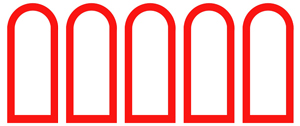
The result is a marketplace where you're free to "relate" inside the silo of your choice:
For evidence, look inside your wallet or purse, or on your keyring. Chances are you're carrying a pile of "loyalty cards" that entitle you to "discounts" that are basically the absence of surcharges for non-"members", and that give those sellers ways to track data about you that's not yours and you'll never see. These systems make full sense only to themselves — for the same reason mainframe computing made sense in its day. Hey, businesses were free to choose between IBM, Honeywell, Digital and Wang.
Of course, companies still get locked into proprietary computing deals of all kinds. But individuals began to become free with the creation of the PC, and networking became free with the creation of the Internet. (By this I mean "free as in freedom, not fee as in beer". We're still far from the ideals of the Free Software Definition, but each of us as individuals has far more freedom of choice in computing and connectivity than we did in the mainframe age.)
But what if we created a new system — a truly free and open marketplace, where vendors could discover that free customers are more valuable than captive ones, and where free markets for customers would mean relating to sellers as equals. Where "relationship" would be voluntary and allow terms set by both parties? Is this a utopian dream or what?
Well, here's what Milton Friedman said in Chapter 1 of Capitalism and Freedom (Chicago: University of Chicago Press, 1962):
Fundamentally, there are only two ways of co-ordinating the economic activities of millions. One is central direction involving the use of coercion--the technique of the army and of the modern totalitarian state. The other is voluntary co-operation of individuals--the technique of the market place.
The possibility of co-ordination through voluntary co-operation rests on the elementary -- yet frequently denied -- proposition that both parties to an economic transaction benefit from it, provided the transaction is bi-laterally voluntary and informed.
No development in the history of civilization does more to support the bi-lateral and voluntary abilities of parties to transact and to inform each other than the Internet. Today the Net is so supportive and essential to our shared economy that it is hard to imagine the civilized world without it — even though we lived in that world less than a generation ago.
Among the Net's most important virtues is the support it gives individuals who wish to perform the "voluntary co-operation" that Friedman calls "the technique of the marketplace." But, while customers have the some ability to speak directly to companies through emails, tweets and blogs, that ain't enough. We need more. We need tools that make customers both independent from vendors and better able to engage with them. And, of course, these tools need to be built on a foundation of free and open code.
Let's say we take one of those silos, turn it sideways, and open it up, so it looks like a magnet instead:

And let's say that represents the vendor.
Now let's do the same for the customer:

Now let's have them face each other, flanking a free and open marketplace:

Making this happen has been my work for the past four years as a fellow at the Berkman Center, and it will continue as we spin out ProjectVRM.org over the next few months. It has also been a goal of mine as an editor for Linux Journal going back more than ten years. It's why I coined "markets are conversations" as the first thesis in The Cluetrain Manifesto. And it's why I've been motivated ever since Chris Locke coined this as "the one clue to get" for Cluetrain as well:

In fact, Chris wrote that before Cluetrain came out. Seeing it adrenalized us, and is one of the main reasons Cluetrain happened. It's been the main reason I've been on a march ever since to make good on that statement. I want customer reach to exceed vendor grasp, for the good of both parties.
Which brings us to EmanciPay. That link goes to our wiki page for the project. Here's how it begins:
Project Overview
EmanciPay is a relationship management and voluntary payment framework in which buyers and sellers can present to each other the requirements and options by which they are willing to engage, or are already engaging. These include:
- choices concerning payment (though not payment itself)
- preferences
- policies
EmanciPay makes use the r-button (two red "magnets") to signal the presence of willingness-to-engage on either or both the buy and sell sides. Here one way it might appear in a browser's chrome:
The user's side is the left magnet, and the seller's side is the right.
The first use case for EmanciPay is the challenge of providing a new revenue source for media and creative works -- in which supply and demand can relate, converse and transact business on mutually beneficial terms, rather than only on terms provided by the countless different silo'd systems we have today, each serving to hold the customer captive, and causing much inconvenience and friction in the process.
EmanciPay will use open standards and be comprised of open source code. While any commercial fourth party can use EmanciPay (or its principles, or any parts of it they like), EmanciPay itself cannot ride on commercial systems. It can, however, support fourth parties by making them substitutable, much as the open standards of email (smtp, pop3, imap) make email systems substitutable. (Each has what Joe Andrieu calls service endpoint portability.)
EmanciPay's own code repository is here.
[Explanation of how it works...]
[Invitation to participate...]
